



Your HVAC system may be running regularly, yet some rooms never seem to reach the temperature you select. You might notice weak airflow, rising energy bills, or an uncomfortable difference between upstairs and downstairs. While these problems can have several causes, leaking ductwork is one possibility homeowners should not overlook.
Heating and cooling systems depend on ductwork to carry conditioned air from the equipment to the rooms throughout a home. When connections loosen, sections become damaged, or gaps develop around joints, some of that air can escape before reaching its intended destination.
For homeowners in Dallas–Fort Worth, United Home Services provides air duct inspection and related services to help identify ductwork problems. Understanding how professional HVAC duct leakage testing works can help you recognize when an inspection may be worthwhile and what to expect from the process.
Why Hidden Air Duct Leaks Matter
Ductwork often runs through attics, crawl spaces, garages, and enclosed ceiling areas. Because much of it stays out of sight, damage can continue without obvious signs at the vents.
A small opening at a connection may allow conditioned air to escape into an unconditioned space. A disconnected section can create a more significant loss. In either situation, the HVAC system may need to operate longer to maintain the desired indoor temperature.
Leaking ducts can contribute to:
- Uneven temperatures between rooms
- Weak airflow from certain supply vents
- Longer heating and cooling cycles
- Higher energy consumption
- Dust entering through gaps in return ductwork
- Reduced overall HVAC performance
The location of a leak also matters. A leak in an attic duct can release conditioned air into a hot space during summer, while a return-side leak may draw air from an unintended area into the HVAC system.
These symptoms do not prove that duct leakage is present. Restricted airflow, dirty filters, equipment problems, insulation issues, and poor duct design can produce similar complaints. Testing and inspection help distinguish between them.
What Is HVAC Duct Leakage Testing?
HVAC duct leakage testing is a process used to evaluate whether air is escaping from the duct system through unwanted openings. Depending on the home’s layout and the problem being investigated, a professional may use visual inspection, airflow measurements, pressure testing, or a combination of diagnostic methods.
It is important to understand that a visual inspection and a calibrated duct leakage test are not necessarily the same service. A technician may identify visible gaps or disconnected sections without measuring the total leakage rate. A formal pressure-based test uses specialized equipment to pressurize or depressurize ductwork and measure the airflow needed to maintain a specified test pressure.
The appropriate method depends on the home’s duct configuration, accessibility, and the reason for the inspection.
How Professionals Find Hidden Duct Leaks
Visual Inspection of Accessible Ductwork
A professional inspection often begins with the duct sections that can be safely accessed. Technicians may examine attic spaces, exposed connections, duct supports, insulation, and visible transitions.
They look for loose joints, separated sections, damaged flexible ducts, crushed areas, deteriorated insulation, and gaps around connections. A duct that has sagged or become compressed may also restrict airflow even if it does not have an obvious opening.
This first stage helps identify visible defects and determines whether additional testing is appropriate.
Camera Inspection of Difficult-to-Reach Sections
Some duct sections cannot be examined properly from the outside. Where suitable access is available, a duct inspection camera can help technicians view the interior of concealed or difficult-to-reach areas.
Camera inspection can reveal internal damage, accumulated debris, tears, or obstructions. It provides useful visual information, although it does not independently measure how much air the entire duct system is losing.
Airflow Performance Assessment
Technicians may compare airflow at different registers and examine how air moves through the system. If one room receives noticeably less air than others, the cause could be a leak, blockage, closed damper, damaged duct, or an incorrectly designed branch.
Airflow measurements help narrow down the possibilities. They are particularly useful when a homeowner reports recurring hot and cold spots or weak airflow in specific rooms.
Pressure-Based Duct Leakage Testing
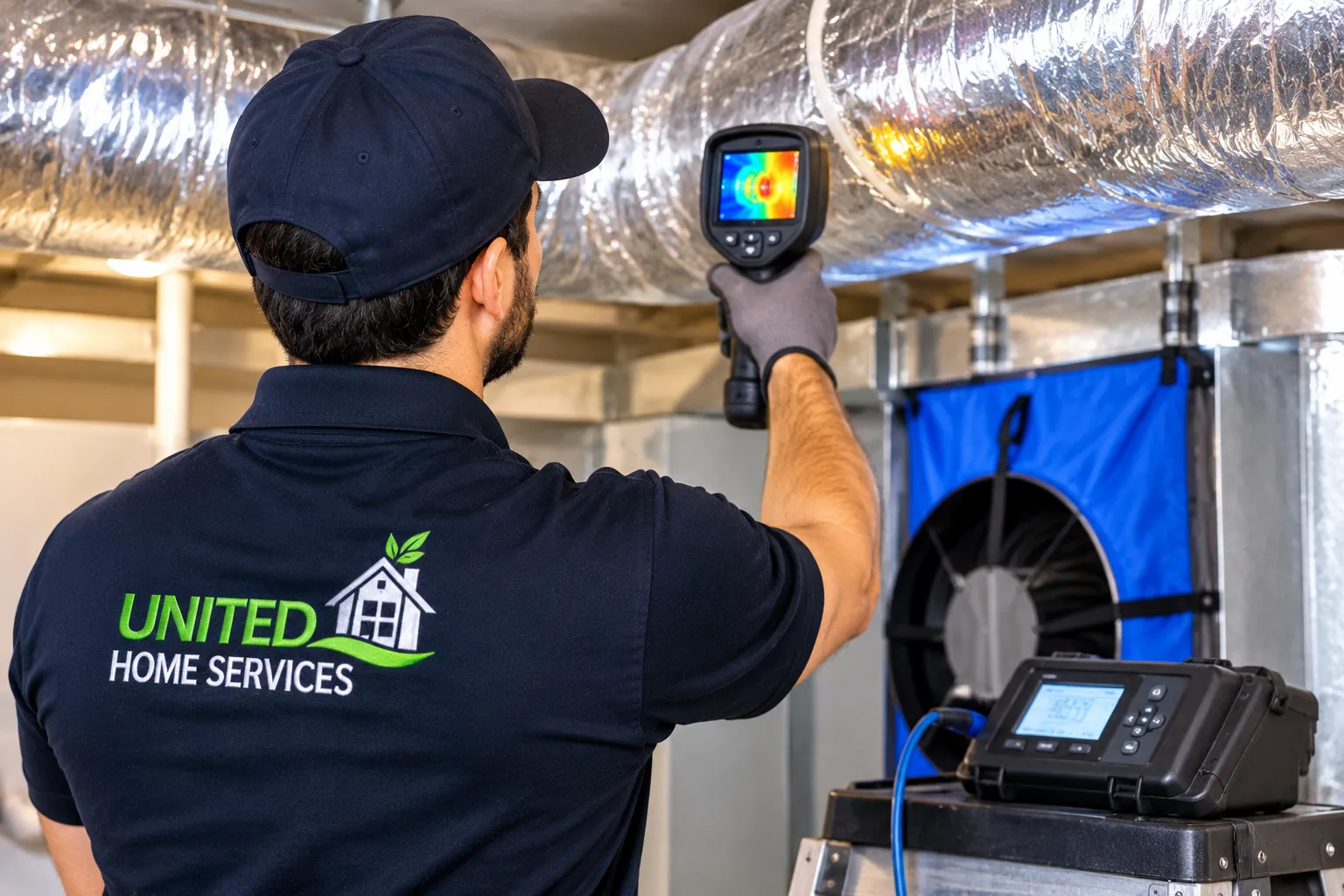
When a more quantitative assessment is needed, a technician may use a duct leakage tester. The equipment typically includes a calibrated fan and pressure-measuring instruments.
The duct system or an isolated section is prepared for testing. Openings are temporarily sealed as required by the test procedure, and the fan is used to establish the specified pressure. The equipment measures how much air is needed to maintain that pressure.
That measured airflow provides an indication of leakage under the test conditions. Some procedures assess total duct leakage, while others are designed to estimate leakage to the outside of the conditioned living space.
These results answer different questions. Total leakage includes air escaping through all unintentional openings within the tested system. Leakage-to-outside testing focuses on air escaping beyond the home’s conditioned envelope. A qualified professional should explain which method is being used and what the results mean.
Locating the Source Before Recommending Repairs
A test result can indicate that leakage exists, but locating the specific problem may require further inspection. Technicians may examine accessible joints, connections, boots, plenums, and transitions.
In some situations, smoke or other suitable visualization methods can help reveal the movement of escaping air. The method must be appropriate for the equipment and the test conditions.
The goal is to connect the diagnostic findings to a practical repair plan rather than recommend sealing or replacing ductwork without identifying the underlying issue.
Common Places Where Duct Leaks Develop
Several parts of a residential HVAC system deserve attention during an inspection.
Duct connections and joints: Connections can loosen over time because of movement, vibration, or poor installation.
Attic ductwork: Temperature extremes and physical damage can affect exposed duct sections, supports, insulation, and connections.
Return-air pathways: Gaps on the return side may allow the system to pull air from unintended spaces.
Supply boots and registers: Poorly sealed connections around the point where ductwork meets a register can allow air to escape into surrounding cavities.
Older or damaged flexible ducts: Tears, compression, and disconnected sections can interfere with proper air delivery.
Why Professional Diagnosis Is Better Than Guesswork
Sealing every visible opening without understanding the system can overlook larger problems. For example, a room with weak airflow might have a disconnected branch, but it could also have an undersized duct, a blocked register, or an airflow-balancing issue.
A professional evaluation helps determine whether the right solution is localized sealing, duct repair, replacement of a damaged section, or further HVAC investigation.
For homeowners looking for a local assessment, DFW air duct inspection services provide a starting point for evaluating accessible ductwork, airflow concerns, and potential leakage. The technician can explain whether the symptoms call for a visual assessment, additional measurements, or a more formal pressure test.
What Homeowners Can Do Before an Inspection
You do not need to enter an attic or dismantle ductwork to prepare for an appointment. A few observations can help the technician understand the problem.
- Note which rooms feel warmer or cooler than others.
- Check whether airflow seems weak at particular vents.
- Replace or clean the HVAC filter according to its instructions.
- Keep supply registers and return grilles unobstructed.
- Mention any recent renovation, ceiling work, or HVAC changes.
- Share when the problem occurs, such as during hot afternoons or when bedroom doors are closed.
Avoid climbing into unsafe spaces or attempting to repair concealed duct connections yourself. Professional access and appropriate equipment are important for a reliable assessment.
Better HVAC Performance Starts With Finding the Real Problem
Hidden duct leaks can affect comfort and system performance, but not every airflow problem is caused by leakage. The most useful approach is to inspect the duct system, evaluate its airflow, and select testing methods that match the symptoms and system design.
For DFW homeowners, a professional duct inspection can help turn unexplained temperature differences and weak airflow into a clearer diagnosis. Identifying the actual problem before choosing a repair is a more dependable way to restore proper air distribution and avoid unnecessary work.
Frequently Asked Questions
What is HVAC duct leakage testing?
It is a diagnostic process used to evaluate air escaping from ductwork through unwanted openings. Depending on the method, it may involve visual inspection, airflow assessment, or pressure-based testing with specialized equipment.
Can a technician find leaks without opening walls?
Often, yes. Accessible attic ducts, exposed connections, and certain concealed sections can be inspected using suitable tools. Some locations may require additional access before they can be assessed properly.
Is a visual duct inspection the same as a pressure test?
No. A visual inspection looks for visible damage and loose connections. A pressure-based test uses equipment to measure the airflow required to maintain a specified duct pressure, helping quantify leakage under the test conditions.
What are common signs of leaking ductwork?
Uneven room temperatures, weak airflow, longer HVAC cycles, and unexplained increases in energy use may indicate duct problems. These symptoms can also have other causes, so an inspection is needed to confirm the issue.
Can return-air duct leaks affect indoor air quality?
They can. A leak on the return side may allow air from an unintended space to enter the system. The effect depends on the leak location and what is present in the surrounding area.
Does every duct leak require duct replacement?
No. Some problems can be addressed by sealing joints or repairing a localized damaged section. Replacement may be appropriate when ductwork has extensive damage or cannot perform properly after reasonable repairs.
How often should residential ductwork be inspected?
There is no single schedule that applies to every home. An inspection is especially useful when airflow changes, rooms become difficult to keep comfortable, ductwork has been disturbed, or the home has undergone renovation.
Should duct cleaning be done before leakage testing?
Not automatically. Cleaning and leakage testing address different issues. If the concern is escaping air or poor airflow, the duct system should be evaluated to determine which inspection or repair is appropriate.